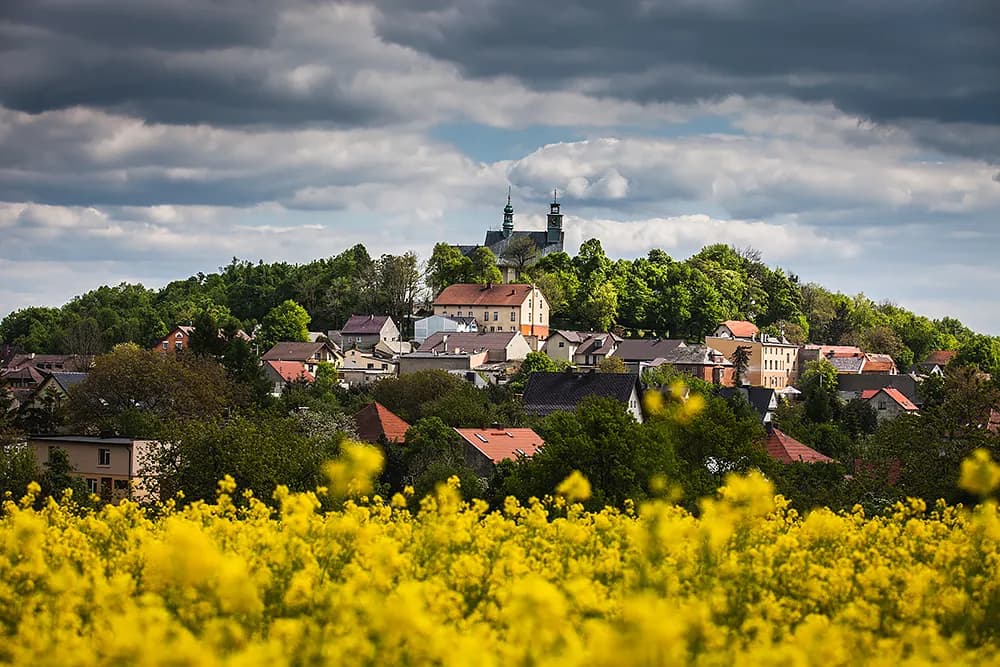
Just over 40 kilometres south-east of Opole, the village of Góra Świętej Anny sits on the highest point of the Chełm Massif. Its wooded slopes, limestone formations and rural surroundings make it an appealing place for a day out, but the landscape carries considerably more history than its peaceful appearance suggests.
For centuries, people have climbed the hill as pilgrims. In the 20th century, the same landscape became a battlefield and a place of political commemoration. Today, the sanctuary, Calvary, museum, monuments, forests and geological features form one of the most distinctive cultural landscapes in the Opole region.
A pilgrimage destination for centuries
The story of Góra Świętej Anny as a religious centre dates back to the late Middle Ages.
A church dedicated to St George was founded here in 1480 by Krzysztof Strzała and his son Krystek. The cult of St Anne developed later, following the arrival of a figure containing her relics.
Franciscans came to Góra Świętej Anny in 1655 at the invitation of Melchior Ferdynand von Gaschin. Their presence helped establish the mountain as one of Upper Silesia's most important pilgrimage destinations.
At the heart of the site stands the Sanktuarium św. Anny Samotrzeciej, alongside the Franciscan monastery. Around it stretches the Kalwaria Annogórska, a network of chapels and paths following the contours of the hills.
The Calvary contains 40 chapels, creating a landscape designed to be experienced on foot. Walking between them is as much a part of the pilgrimage tradition as reaching the sanctuary itself.
A landscape of forests, limestone and volcanoes
There is another story beneath the religious heritage.
Góra Świętej Anny lies within the Park Krajobrazowy Góra Św. Anny, established in 1988. Covering around 5,051 hectares, the park protects a varied landscape of forests, meadows, agricultural land, valleys and historic avenues.
The geology is particularly distinctive. Limestone formed here during the Triassic period, around 240 million years ago, while volcanic activity much later shaped other parts of the landscape.
The result is a mixture of limestone and volcanic formations that helps explain the area's designation as a National Geopark.
For walkers, the geological history is largely hidden beneath the trees and fields. But it is one of the reasons the mountain looks and feels different from much of the surrounding Opole region.
The battle for Góra Świętej Anny
The peaceful character of the mountain can make its military history difficult to imagine.
In 1921, Góra Świętej Anny became the scene of some of the fiercest fighting during the Third Silesian Uprising. The conflict formed part of the struggle over the future of Upper Silesia following the First World War and the plebiscite held in the region.
The events left a lasting mark on the landscape.
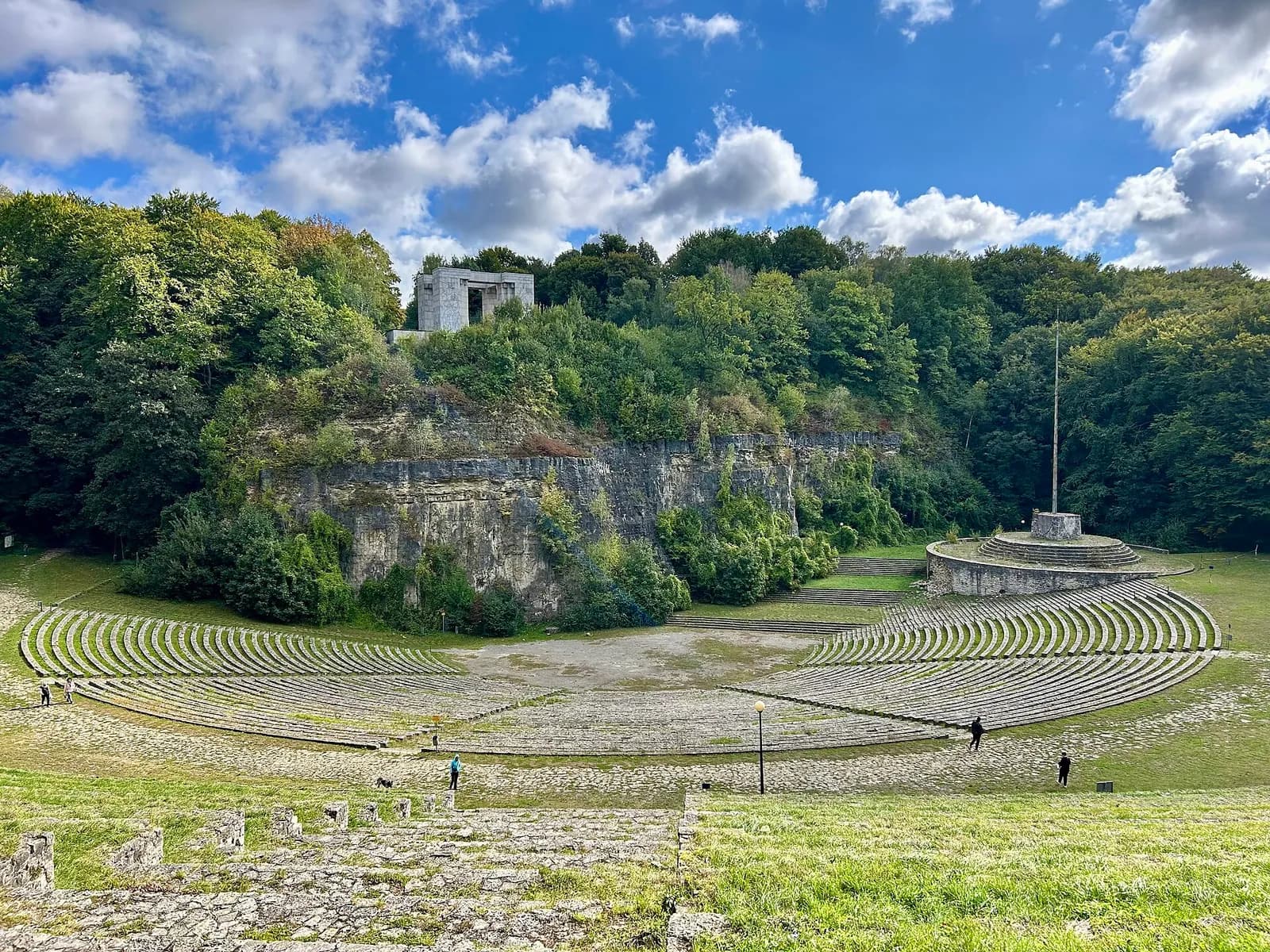
Today, the most prominent reminder is the Pomnik Czynu Powstańczego (Monument to the Uprising), designed by sculptor Ksawery Dunikowski and completed in 1955. Its monumental forms stand beside the great rock amphitheatre, creating one of the most recognisable views on the mountain.
The monument itself also has a complicated history. It replaced an earlier German memorial complex built during the interwar period. That earlier site commemorated German soldiers and reflected the political tensions surrounding Upper Silesia at the time.
This layering of memory is an important part of Góra Świętej Anny. The same hill has been given very different meanings by successive generations.
Inside the Museum of the Silesian Uprising
The Muzeum Czynu Powstańczego provides a useful starting point for understanding this history.
Its exhibitions focus on the Silesian Uprisings and the political and social circumstances surrounding them. For anyone unfamiliar with the history of Upper Silesia, a visit helps put the monuments and landscape into context.
The story is particularly relevant to the Opole region. The borders and identities of Upper Silesia changed dramatically during the 20th century, leaving behind a cultural landscape where Polish and German influences remain visible.
The amphitheatre and the Monument to the Uprising
The rock amphitheatre below the monument is one of the site's most striking spaces.
Built into the natural terrain, it was created during the interwar period and later became closely associated with the post-war monument complex. Its scale is easy to appreciate when standing inside it, particularly when compared with the surrounding woodland.
The combination of amphitheatre, forest and monumental architecture gives this part of Góra Świętej Anny a very different atmosphere from the sanctuary and Calvary.
It also demonstrates how dramatically the character of a place can change simply by walking a few hundred metres.
A day trip from Opole
Góra Świętej Anny works well as a day trip from Opole because several different experiences can be combined without covering a large area.
A visit could include:
the St Anne sanctuary and Franciscan monastery
sections of the historic Calvary
the Grota Lurdzka
the Pomnik Czynu Powstańczego
the rock amphitheatre
the Muzeum Czynu Powstańczego
walking routes through the landscape park
geological features and viewpoints around the mountain
The best way to appreciate the place is to allow time for walking rather than treating it as a quick stop at the sanctuary. The relationship between the buildings, paths, forests and open countryside is a central part of its character.
The village and its surrounding cultural landscape were designated a Pomnik Historii in 2004, recognising the exceptional combination of historic buildings, designed landscape and natural setting.
One mountain, many layers of Silesian history
Góra Świętej Anny brings together an unusual range of stories in a relatively small area.
A medieval religious tradition continues at the sanctuary. The Calvary reflects centuries of pilgrimage. The surrounding park protects a landscape shaped by geology, agriculture and woodland. The museum and monuments recall the upheavals of the early 20th century.
None of these stories exists in isolation. They are all visible from the same paths and roads, sometimes within minutes of one another.
That is what makes Góra Świętej Anny such a rewarding place to explore from Opole. It offers the chance to step into the landscape rather than simply read about the region's history, while the forests, hills and walking routes provide plenty of space to slow down and take it in.
See more: When Opole Smelled of Inka: The Story Behind Poland’s Famous Grain Coffee
Image credit: Błażej Duk, Wikimedia Commons, CC BY-SA 4.0 / Olgierd Rudak, Wikimedia Commons, CC BY-SA 4.0