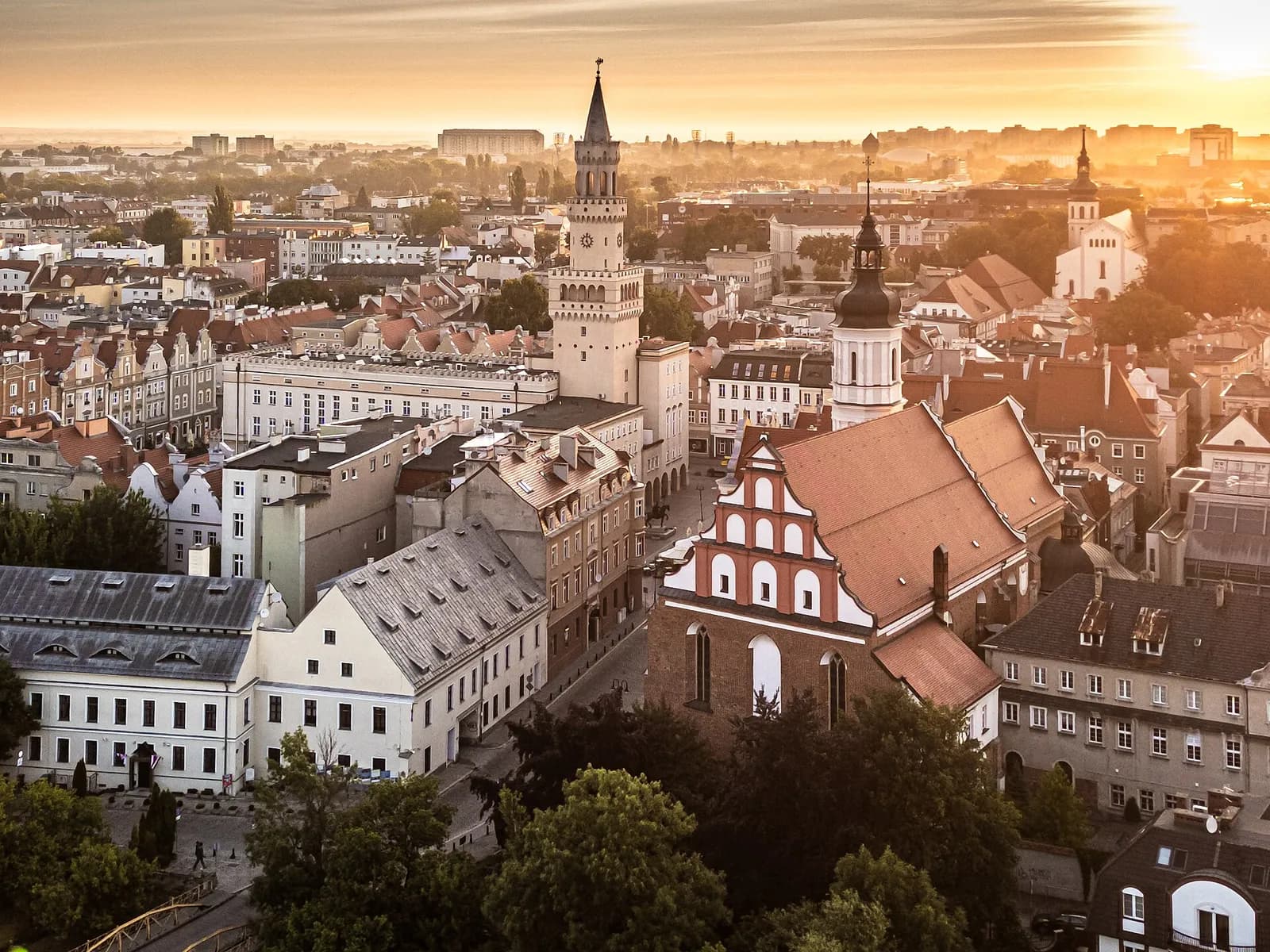
Located on the banks of the Oder (Odra) River in southern Poland, Opole is a city shaped by more than a thousand years of political change, trade, culture and community life.
Its origins are connected with early Slavic settlement on Ostrówek Island, where archaeological discoveries reveal one of the region’s important medieval centres. Over the centuries, Opole developed from a fortified settlement into a Piast stronghold, a trading centre and today a cultural capital of the Opole Voivodeship.
Early Settlement on Ostrówek Island
The history of Opole begins with an early Slavic settlement established on Ostrówek Island, located in the middle of the Oder River.
Archaeological research has identified remains of settlement activity and defensive structures dating back to the early medieval period. A reference to a settlement in the area appears in the Descriptio civitatum, a 9th-century work associated with the Bavarian Geographer, although interpretations of early medieval records continue to vary among historians.
The settlement was associated with the Opolan tribe, a Slavic community that gave the city its name. Its location along the Oder provided both natural protection and access to important routes connecting different parts of Central Europe.
From Piast Rule to Medieval Stronghold
During the formation of the Polish state, Opole became part of the Piast realm. Around 990, Duke Mieszko I incorporated Silesia into the early Polish state, bringing the area under Piast control.
Although the region experienced periods of political competition, including influence from Bohemia, Opole eventually became an important administrative centre within medieval Silesia.
By the 12th century, the settlement had developed into a castellany, serving as a centre of local administration and defence.
In 1172, Opole became the capital of the Duchy of Opole under the Piast dynasty. Duke Casimir I of Opole, a descendant of Bolesław III Wrymouth, supported the city’s development and granted urban privileges before 1217.
The Piast Tower: A Symbol of Medieval Opole
One of Opole’s most recognisable landmarks is the Piast Tower (Wieża Piastowska), the surviving remains of the medieval Piast castle complex.
Construction of the castle began in the 13th century on Pasieka Island, creating one of the important defensive centres of the Piast territories in Silesia.
Today, the Piast Tower remains one of the city’s most important symbols, representing Opole’s medieval origins and its long connection with the Piast dynasty.
Trade, Industry and Urban Growth
Throughout the medieval and Renaissance periods, Opole developed as a commercial centre.
Its location near important trade routes helped support economic growth, with merchants and craftsmen contributing to the city’s development. The Oder River also played an important role in regional transport and commerce.
The 19th century brought further transformation. After Opole became the seat of a regency administration in 1816, the city gained greater regional importance.
Railway connections, including links to Brzeg and Wrocław in 1843, improved transport and encouraged industrial development. New manufacturing facilities opened during the century, contributing to Opole’s growth as a modern urban centre.
War, Borders and Post-War Reconstruction
The 20th century brought significant changes to Opole and the wider Silesian region.
Following the Upper Silesian plebiscite of 1921, Opole remained within Germany. The city experienced the political tensions of the interwar period and later suffered heavy damage during the Second World War.
In early 1945, fighting between German and Soviet forces caused extensive destruction, with large parts of the city damaged. After the war, decisions made by the Allied powers at Yalta and Potsdam resulted in Opole becoming part of Poland.
The post-war period brought major reconstruction and demographic change. The city was rebuilt and gradually developed into an important administrative, educational and cultural centre.
Opole Today: Culture, Education and Identity
In 1950, Opole became the capital of the newly established Opole Voivodeship, strengthening its role as a regional centre.
Further developments followed, including the creation of the Diocese of Opole in 1972 and the establishment of the University of Opole in 1994. Since 1999, Opole has continued as the capital of the Opole Voivodeship following Poland’s administrative reforms.
The city is also known for its multicultural character. The wider Opole region has one of Poland’s largest German minority communities, which contributes to the area’s distinctive cultural identity through language, traditions and local organisations.
The National Festival of Polish Song
Opole is widely recognised across Poland as the home of the National Festival of Polish Song, one of the country’s best-known music events.
First held in 1963, the festival has become an important part of Polish popular culture, bringing performers, audiences and media attention to the city each year.
The event remains closely connected with Opole’s identity as a centre of music and culture.
A City Connecting Past and Future
From its early settlement on an island in the Oder River to its modern role as a regional capital, Opole’s history reflects the wider story of Silesia.
Its medieval landmarks, multicultural traditions and cultural institutions continue to connect today’s residents with the many communities and historical events that shaped the city.
Opole is a city where centuries of history remain visible in everyday life. Its Piast heritage, riverside location, cultural traditions and diverse communities have created a unique identity within Poland.
From medieval fortress to modern cultural centre, Opole continues to preserve its past while developing its future.