For more than seven decades, musicians from Opole have carried the city's musical identity far beyond Poland, from European concert halls to stages across the world.
When the Opole Symphony Orchestra was founded in 1952, it was a relatively young ensemble in a city rebuilding its cultural life after the Second World War.
More than seven decades later, the orchestra has performed in some of Europe's most distinguished concert halls and travelled as far as China, Argentina, Brazil and the United States.
The journey from a regional symphony orchestra to the Józef Elsner State Philharmonic is therefore also a story about the growing cultural presence of Opole itself.
The institution has changed its name and developed considerably since its foundation, but its central role has remained remarkably consistent: bringing orchestral music to audiences in Opole while representing the city and region beyond its borders.
From a new orchestra to the Józef Elsner Philharmonic
The ensemble began life in 1952 as the Opole Symphony Orchestra. Five years later, it became the State Symphony Orchestra in Opole, before adopting the name of Józef Elsner in 1969.
Elsner provides an especially meaningful connection to the region's musical history. The composer, conductor and teacher was born in Głogów, but spent important periods of his life in the Opole region. He is also remembered as an influential teacher of Fryderyk Chopin.
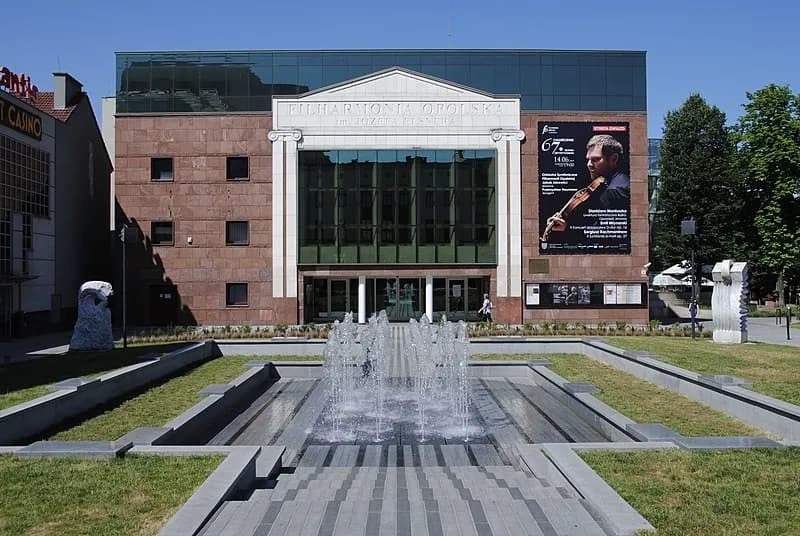
In 1972, the institution took its present form when the Minister of Culture and Art established the Józef Elsner State Philharmonic in Opole.
The change marked an important stage in the development of an institution that had already begun building a reputation beyond the city.
Over the decades, the Philharmonic has welcomed a remarkable range of conductors and soloists from Poland and abroad. Pianists, violinists, singers and instrumentalists have appeared with the orchestra alongside generations of Polish conductors and composers.
That history of collaboration has helped keep the orchestra connected to both the established classical repertoire and the continuing development of musical life.
When Opole takes its place on the international stage
The orchestra's reputation is perhaps most visible in the places where it has performed.
Its international appearances have included the Philips Saal in Rotterdam, Teatro Municipale in Piacenza, the Herkulessaal in Munich and the Golden Hall of Vienna's Musikverein, one of the world's best-known concert venues.
The Philharmonic has also represented Poland at significant international occasions.
In 2000, the orchestra performed in Rome during celebrations marking the 80th birthday of Pope John Paul II, where it was the only Polish ensemble participating in the celebrations.
Four years later, it represented Poland in Brussels during the ceremony marking the European Union's enlargement, as well as performing in Salzburg.
Its touring history extends well beyond Europe. Performances in China, Argentina, Brazil and the United States have placed Opole musicians before audiences far from their home city.
These journeys have also formed part of a wider festival presence. The orchestra has appeared at events including the Poznań Musical Spring Festival of Polish Contemporary Music, the Festival of Polish Contemporary Music in Wrocław and the Jan Kiepura Festival in Krynica-Zdrój, alongside international events in Switzerland.
The significance of these appearances lies not simply in the number of countries visited. They show how an institution rooted in one Polish city can become part of a much wider cultural conversation.
A tradition that continues to evolve
The Philharmonic's work extends beyond the concert platform. Its artistic output includes recordings of music by composers ranging from Johannes Brahms and Antonio Vivaldi to Karol Szymanowski, Feliks Nowowiejski, Witold Maliszewski and Józef Elsner.
A three-disc recording of Witold Maliszewski's symphonic works, conducted by Przemysław Neumann, received a Fryderyk nomination in 2022 in the Symphonic Music Album of the Year category.
Today, the orchestra continues this tradition under a new generation of musical leadership.
Among its current artistic figures is conductor Jakub Chrenowicz, who serves as the Philharmonic's Deputy Director and First Conductor. His career has taken him from the National Philharmonic in Warsaw and major Polish orchestras to opera houses and concert institutions in Poland and abroad.
His work has included performances with ensembles such as Sinfonia Varsovia, the Polish National Radio Symphony Orchestra in Katowice and orchestras in Poznań, Kraków, Łódź, Gdańsk, Koszalin and Opole.
His presence at the Philharmonic illustrates the continuing relationship between Opole and the wider Polish musical world.
That relationship has always worked in both directions. The Philharmonic brings international artists to Opole, while its own musicians carry the city's name to audiences elsewhere.
After more than seventy years, that exchange has become part of the institution's identity. The Opole Philharmonic is no longer simply an orchestra founded in the early years of post-war cultural reconstruction. It has become one of the city's established cultural ambassadors, connecting local audiences with the international world of classical music.
Its story demonstrates that a cultural institution does not have to choose between being rooted in its home city and looking outward. For the Opole Philharmonic, those two roles have developed together, with the music travelling further while its connection to Opole remains at the centre.
Visitor Information
Józef Elsner Opole Philharmonic
ul. Krakowska 24, Opole